السلام عليكــم ورحمـة الله تعالى و بركاتــه
مستخرج من الفصل الأول (المقدمة) من الكتاب Perl for System Administration للكاتب David N. Blank-Edelman
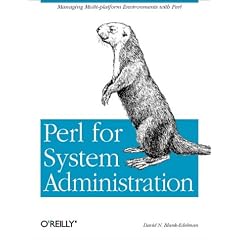
هذا الكتاب من الكتب المحترمة للقيمة المعرفية التي يقدمها في مجال "إدارة نظام التشغيل" باستعمال البيرل
الملاحظة بشأنه (كما ذكر الكاتب) هي أن يكون القارئ يمتلك حد أدنى (الأساسيات) لفهم الأمثلة و التطبيقات البرمجية
و كما ذكر أحد قراء هذا الكتاب : الكاتب ليس محترف بيرل (أو أنه تعمد التبسيط - رأيي الشخصي -) عند كتابة التطبيقات، لذلك يمكن تحسين محتوى الإجراءات إلى أكواد مختصرة (و طبعا صعبة الفهم لغير المندمجين مع هذه اللغة)
الأن أحببت أن استخرج بعض الفقرات من الفصل الأول للكتاب
اقتباسSystem Administration Is a Craft
In my town, several of our local bus lines are powered by cables strung high above the street. One day, when going to an unfamiliar destination, I asked the driver to let me know when a particular street was approaching. He said, "I'm sorry, I can't. I just follow the wires."
These are words you will never hear good system administrators use to describe their job. System and network administration is about deciding what wires to put in place, where to put them, getting them deployed, keeping watch over them, and then eventually ripping them out and starting all over again. Good system administration is hardly ever rote, especially in multiplatform environments where the challenges come fast and furious. Like any other craft, there are better and worse ways to meet these challenges. This book is for the people who face those challenges, either as full-time system administrators or part-time tinkerers. I'll try to show you how Perl can help.
اقتباسHow Perl Can Help
System administration work should use any and every computer language available when appropriate. So why single out Perl for a book?
The answer to this question harkens back the to the very nature of system administration. Rémy Evard, a colleague and friend, once described the job of a system administrator like this: "On one side, you have a set of resources: computers, networks, software, etc. On the other side, you have a set of users with needs and projects--people who want to get work done. Our job is to bring these two sets together in the most optimal way possible, translating between the world of vague human needs and the technical world when necessary."
System administration is often a glue job; Perl is one of the best glue languages. Perl was being used for system administration work well before the World Wide Web came along with its voracious need for glue mechanisms.
Perl has several other things going for it from a system administration perspective:
• It is clearly an offspring of the various Unix shells and the C language, tools many system administrators are comfortable using.
• It is available on almost all modern operating systems. It does its best to present a consistent interface on each. This is important for multiplatform system administration.
• It has excellent tools for text manipulation, database access, and network programming, three of the mainstays of the profession.
• The core language can easily be extended through a carefully constructed module mechanism.
• A large and dedicated community of users has poured countless hours into creating modules for virtually every task. Most of these modules are collected in an organized fashion (more on these collections in a moment). This community support can be very empowering.
• It is just plain fun to program.
In the interest of full disclosure, it is important to note that Perl is not the answer to all of the world's problems. Sometimes it is not even the appropriate tool for system administration programming because:
• Perl has a somewhat dicey object-oriented programming mechanism grafted on top of it. Python is much better in this regard.
• Perl is not ubiquitous. You are more likely to find the Bourne shell than Perl on a system as it comes off the shelf.
• Perl is not always simple or internally self-consistent and is chock full of arcania. Tcl has far fewer surprises.
• Perl has enough power and esoterica to shoot you in the foot.
The moral here is choose the appropriate tool. More often than not, Perl has been that tool for me, and hence this book
اقتباسThis Book Will Show You How
In the 1966-68 "Batman" television show, the dynamic duo wore utility belts. If Batman and Robin had to scale a building, Batman would say, "Quick Robin, the Bat Grappling Hook! " Or Batman would say, "Quick Robin, the Bat Knockout Gas!" and they'd both have the right tool at hand to subdue the bad guys. This book aims to give you the utility belt you need to do good system administration work.
Every chapter attempts to provide you with three things.
Clear and concise information about a system administration domain.
In each chapter we discuss in depth one domain of the system administration world. The number of possible domains in multiplatform system administration is huge, far too many to be included in a single book. The best survey books on just Unix system administration, Essential System Administration, by Æleen Frisch (O'Reilly & Associates), and Unix System Administration Handbook, by Evi Nemeth, Garth Snyder, and Trent R. Hein (Prentice-Hall), are two and three times, respectively, the size of this book. We'll be looking at topics from three different operating systems: Unix, Windows NT, Windows 2000, and MacOS.
As a result, some hard choices were made on what to include and what to exclude. In general the topics that I believe will become even more important over the next five years made the cut. Important technologies like XML are explored because they are likely to have a significant impact on the field as time goes by. Unfortunately, these guidelines meant that some system administration stalwarts like backup and printing are edged out by newer topics like LDAP and SNMP. The skills and tools provided by this book can help with the domains I omit, but a direct treatment will have to be found elsewhere.
I've tried to put together a good stew of system and network administration information for people with varying levels of experience in the field. Seasoned veterans and new recruits may come away from this book having learned completely different material, but everyone should find something of interest to chew on. Each chapter ends with a list of references which can help you get deeper into a topic should you so choose.
For each domain or topic, especially the ones that have a considerable learning curve, I include appendixes with all of the information you need to come up to speed quickly. Even if you're familiar with a topic, you may find these appendixes can round out your knowledge about that matter (e.g., how something is implemented on a different operating system).
Perl techniques and approaches that can be used in system administration.
To get the most out of this book, you'll need some initial Perl background. Every chapter is full of Perl code that ranges in complexity from beginner to advanced levels of Perl knowledge. Whenever we encounter an intermediate-to-advanced technique, data structure, or idiom, I'll take the time to carefully step us through it, piece by piece. In the process, you should be able to pick up some interesting Perl techniques to add to your programming repertoire. The hope is that Perl programmers of all levels will be able to find something to learn from the examples presented in this book. And as your Perl skills improve over time, you should be able to come back to this book, learning new things each time.
To further enhance this learning experience, I will often present more than one way to accomplish the same task using Perl rather than showing a single limited answer. Remember the Perl motto, "There's More Than One Way To Do It." These multiple-approach examples are designed to better equip your Perl utility belt: the more tools you have at hand, the better the choices you can make when approaching a new task.
Sometimes it will be obvious that one technique is superior to the others. But this book only addresses a certain subset of situations you may find yourself in, and a solution that is woefully crude for one problem may be just the ticket for another. So bear with me. For each example I'll try to show you both the advantages and drawbacks of each approach (and often tell you which method I prefer).
System administration best practices and deep principles.
As I mentioned at the start of this chapter, there are better and worse ways to do system administration. I've been a system and network administrator for the last 15 years in some pretty demanding multiplatform environments. In each chapter I try to bring this experience to bear as I offer you some of the best practices I've learned and the deeper principles behind them. Occasionally I'll use a personal "war story from the front lines" as the starting point for these discussions. Hopefully the depth of the craft in system administration will become apparent as you read along
الكتاب مرفق في المكتبة العامة للمنتدى على الرابط هنا: /index.php?showtopic=182062
قراءة مفيدة لكل مدير نظام - مبرمج بيرل - .... للجميع
:)